Wild Mushrooms Online
Species guideIn seasonLookalikesIdentifyRecipesArticlesMembers' findsCoursesForagers ClubSafety
Sign in
Sign inSpecies guideIn seasonLookalikesIdentifyRecipesArticlesMembers' findsCoursesForagers ClubSafety
Wild MushroomsOnline

A UK field guide and foragers club: species, seasons, recipes and the finds our members bring back from the woods.

Learn

Species guideForaging calendarLookalikes comparedRecipesArticles & field notesForaging safety

Take part

Members' findsCourses & eventsForagers ClubRecommended kit

About

About the siteSign in or join

Identification information is offered in good faith for education. Eating wild fungi is always at your own risk, and some species are deadly. Some links to kit are affiliate links, which help pay for the site at no extra cost to you. As an Amazon Associate I earn from qualifying purchases.

© 2026 Wild Mushrooms Online. All rights reserved.

← Species guide

Honey Fungus

Armillaria mellea · Physalacriaceae

Also called Bootlace Fungus; Armillaria (several close species)

Edible with caution

The tree-killing parasite of woods, parks and gardens, fruiting in dense honey-to-tawny clumps on stumps and at the base of trees from late summer into early winter. Edible only young and thoroughly cooked, it upsets some people, and its clumps can hide the deadly Funeral Bell.

From Chris's field notesRead Chris's field article: Honey fungus: friend of no gardener →Chris's column on the tree-killing parasite: bootlaces, eating it carefully, and the Funeral Bell that hides in its clumps.
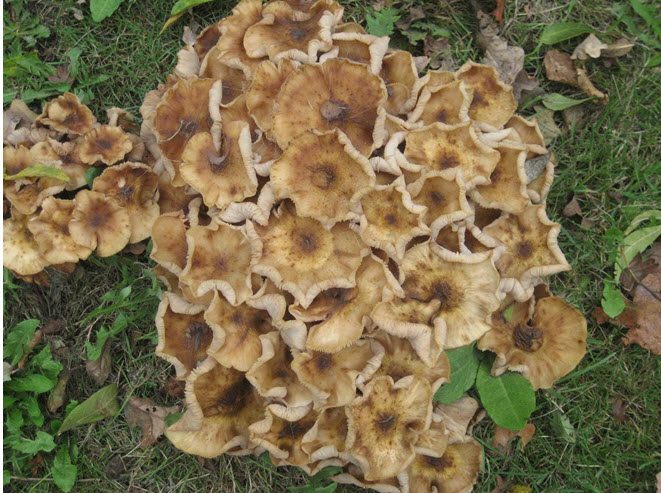
Honey Fungus, photograph 1 of 4
Original photograph · 1 of 4 · Photos alone cannot confirm identification

Edible with caution. Poisonous raw or undercooked, and some people react even when it is well cooked. Eat only young caps, cook thoroughly, try a small amount first and avoid alcohol with it. Take a spore print of every clump to rule out the Funeral Bell.

Read the full foraging safety guidance.

Season

August to December

J
F
M
A
M
J
J
A
S
O
N
D

Where it grows

  • Broadleaf woodland
  • Stumps
  • Living trees
  • Gardens
  • Parks

Identification

Cap
3-15cm, honey-yellow to tawny brown, with fine dark hair-like scales concentrated at the centre; convex, then flat. Grows in dense tufts with the stems fused at the base.
Gills / pores
White to cream, becoming pinkish-brown or spotted with age; attached or running slightly down the stem.
Stem
6-15cm, tough and fibrous, with a thick whitish to yellowish cottony ring near the top. Black bootlace-like strands (rhizomorphs) under the bark of infected wood.
Flesh
White and firm in the cap; stem stringy.
Spore print
White to pale cream.
Smell & taste
Strong and mushroomy; raw taste astringent and unpleasant.

Lookalikes

Funeral Bell (Galerina marginata) is deadly: smaller, with a fragile ring and a rusty-brown spore print, usually on conifer wood. Sulphur Tuft has sulphur-yellow to greenish gills, no proper ring and a purple-brown spore print. Shaggy Scalycap is covered in coarse scales and has brown spores. Velvet Shank has no ring and a dark velvety stem.

In the kitchen

Young caps only; discard the tough stems. Many foragers parboil and discard the water, then fry or stew. Never eat it raw.
Advertisement

Share Facebook X

Useful kit

Affiliate links
  • Opinel No.8 Mushroom Knife

    Curved blade with a boar bristle brush in the handle. The standard foraging knife for good reason.

    Around 20 GBP
  • Traditional Willow Basket

    Open weave so spores drop as you walk and nothing sweats into mush. A plastic bag ruins a haul.

    Around 35 GBP
  • Collins Fungi Guide

    The most complete British field guide in one volume. Heavy, but nothing else comes close for detail.

    Around 30 GBP

As an Amazon Associate I earn from qualifying purchases.

Found one?

Post a photo to the members' feed and let other foragers weigh in before you decide anything.

Post your find →

Also caution

Conifer Parasol in the field

Conifer Parasol

Chlorophyllum olivieri

Edible with caution

A shaggy parasol-like mushroom in coniferous woodland. Several similar species require careful separation.

J
F
M
A
M
J
J
A
S
O
N
D

Field Blewit

Lepista saeva

Edible with caution

A pasture mushroom with a dull buff cap and an unmistakable violet-blue stem.

J
F
M
A
M
J
J
A
S
O
N
D

Common Inkcap

Coprinopsis atramentaria

Edible with caution

Edible in itself, but it causes a violent reaction with alcohol taken up to three days later.
J
F
M
A
M
J
J
A
S
O
N
D
Edit with