
Originally published on Wild Mushrooms Online on 19 November 2014. This is Chris's article in his own words. Small corrections are shown [in square brackets], and there are 2026 notes at the end.
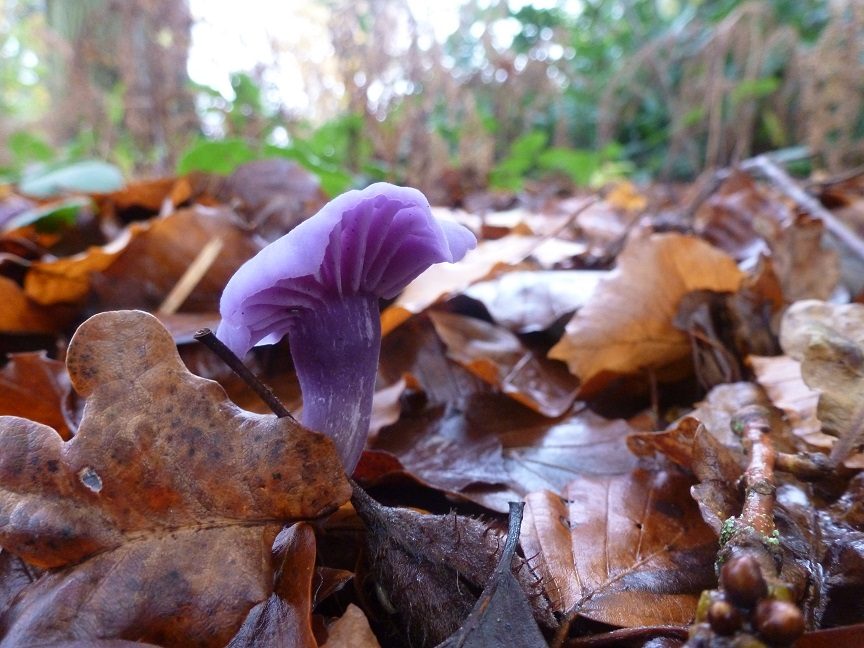
Laccaria amethystina (occasionally incorrectly Laccaria amethysea).
When out in one of my favourite places to pick wild mushrooms, there is one I can always fall back on, as it grows in abundance in many woodlands, particularly in the UK around beech – The Amethyst Deceiver.
Trees, fungi and springtails
If I had one recommendation for anybody looking into learning more about wild mushrooms, it would be to ensure they have a basic understanding of common local flora, especially trees. Trees and fungi regularly form an important symbiotic relationship, often one that has evolved with the mycelium of the fungus acting to assist the tree's root system in breaking down the available nutrients, whilst then being able to access some of the available carbon from the tree.
Fascinatingly, a related Laccaria bicolor has been shown to be effectively carnivorous – luring insects (specifically springtails) in before killing them to make them available for up to 25% of the nitrogen requirement of the tree! [The original web link no longer works; the study is listed under "Checked against" below.] If I am honest, I know nothing of any study of the relationship for Laccaria amethystina specifically, but personally I have noticed more springtails on these than any other mushroom I collect regularly…
What it looks like
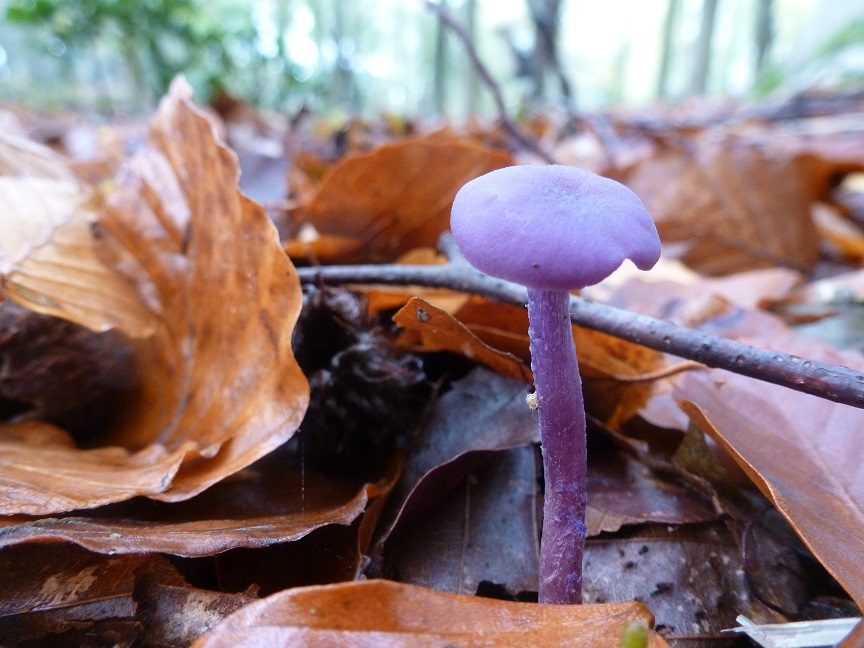
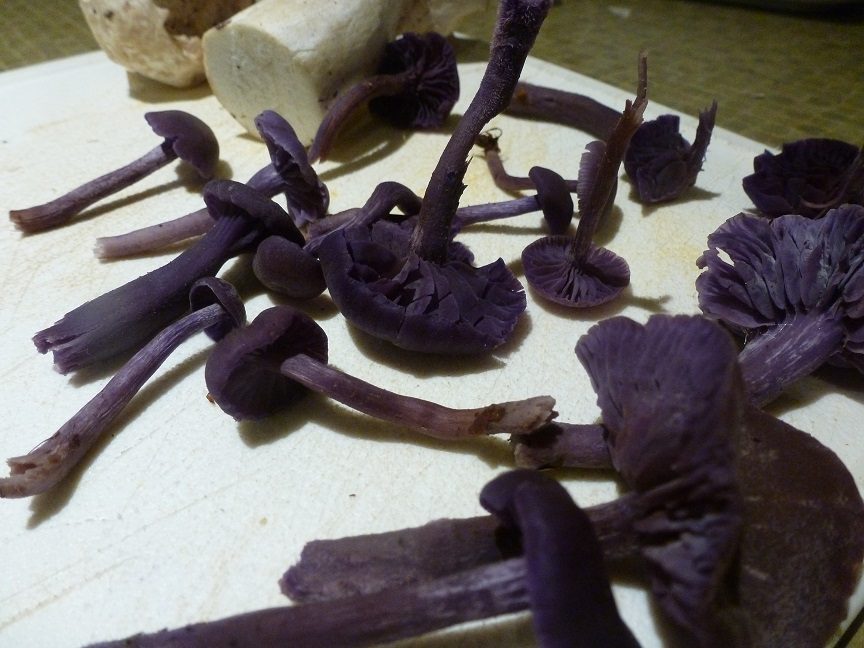
The Amethyst deceiver is a small, bright purple mushroom. It is usually between 0.6cm [the original said 0.6mm] and 4cm, but I've found some older specimens can be as wide as 8cm, although usually they are very variable in shape when they are this size and often past their best for collecting to eat. The cap is convex then becoming flattened to centrally depressed with time.
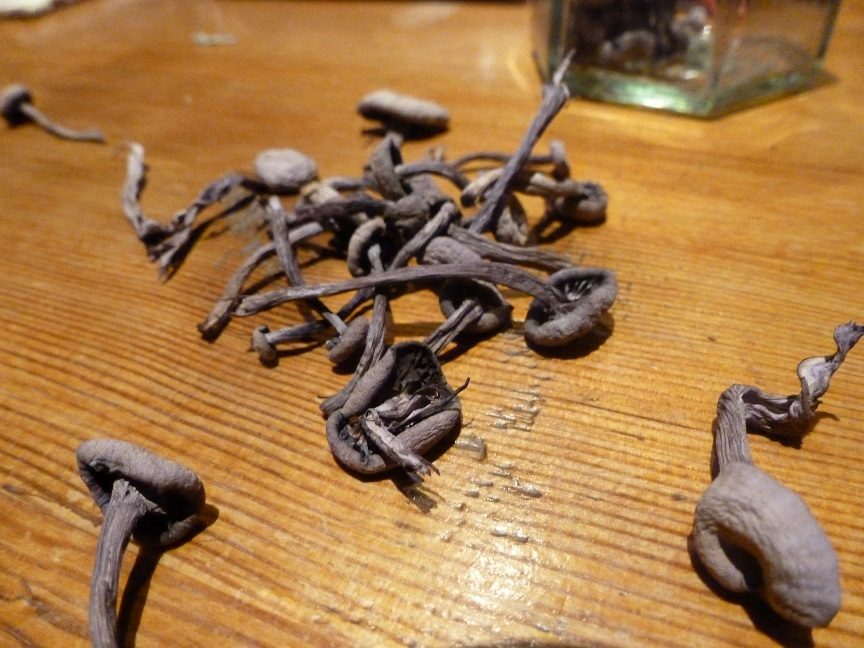
They are a very deep purple-lilac, (the colour of Amethyst crystal gives them part of their name) especially when it is damp, but they dry a much softer lavender-buff colour. They are part of the Laccaria, the "deceivers" – a genus named as their appearance can be so variable – this means whilst they are simple enough to recognise, you should be familiar with the fundamentals of mushroom identification, and as always NEVER EAT ANYTHING YOU ARE NOT 100% SURE OF.
One other consideration as with many mushrooms is their ability to bioaccumulate toxins from a soil, and the amethyst deceiver can do this with arsenic – it is always advisable to have a knowledge about the history of the use of the land where you are picking if you intend to eat them.
The gills are concolorous with the cap, as is the stem, which becomes hollow and covered in whitish fibres down towards the base where it attaches to the lilac coloured mycelium.
When and where
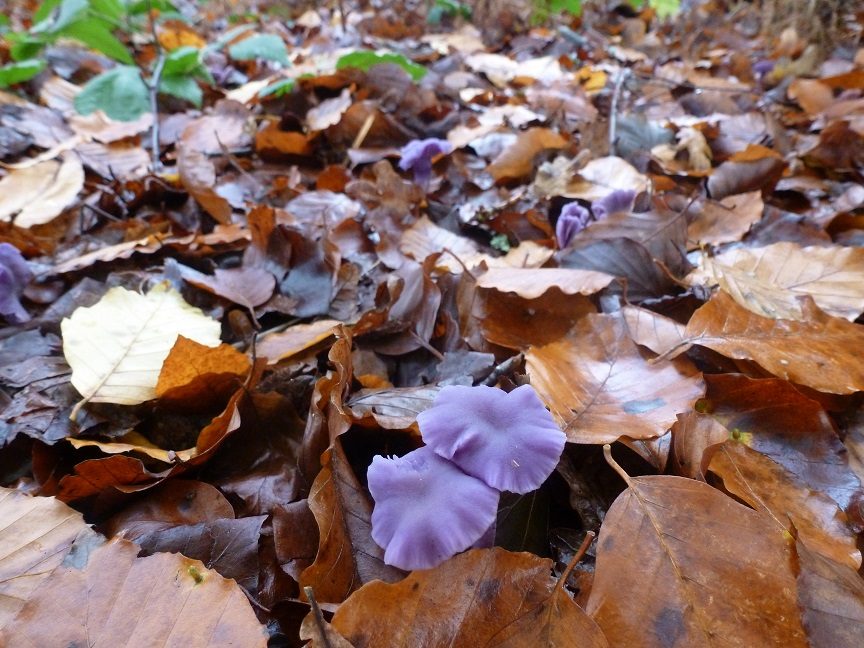
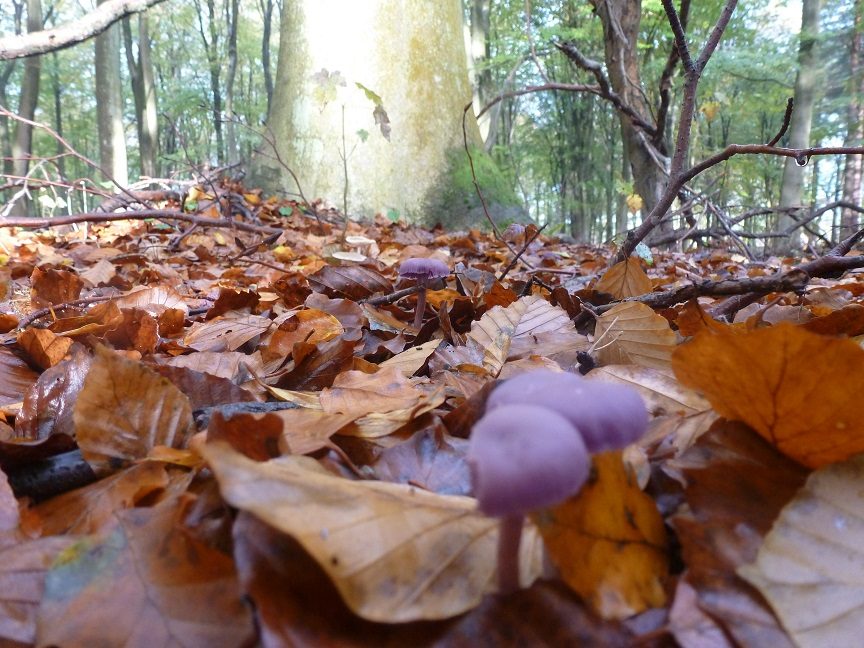
This mushroom is commonplace from mid to late summer until after the frosts get heavier in early winter, and is locally abundant forming large groups. Note the leaf litter is predominantly fallen beech leaves in the pictures below.
In the kitchen, and the lookalike
Although like all Laccaria, this is not considered a "choice" edible species – to be frank it is quite bland and a little chewy for some, it can be relied upon to provide and when there are enough I find it is well worth collecting.
One of the few species it could potentially be confused with is the lilac fibrecap, (Inocybe geophylla var. lilacina [now listed in the UK as Inocybe lilacina]), but whilst the lilac fibrecap has brown coloured spores, the amethyst deceiver has white spores which can occasionally be seen in the gills – if you look closely to the one farthest right of the below picture you can see some:
Fresh versus dried
Here are some dried, a stark reminder that this mushroom weathers a lot of its colour out, and can be very variable with age. If in doubt, leave it out – I usually find enough bright amethyst coloured ones to never have to question anything, and I suggest you take this view too – it really is not a mushroom that is worth taking any risk for!
Before you go
If you do go out collecting these or any other wild mushrooms, please be aware that this article is not intended as a field guide. I would always recommend cross-referencing at least 3 authoritative books on the subject, [see our Kit page for the field guides we recommend] and NEVER, EVER EAT ANYTHING YOU AREN'T SURE OF!
Also, consider the amount you are taking and ensure it is never more than you truly need – all plants and animals have an important role in the delicate balance of any ecosystem, but especially our ancient woodlands so please be respectful in your approach to wild mushroom collecting.
Thanks, Chris
2026 notes
The name: Laccaria amethystina is still the accepted name. "Laccaria amethystea" is an older name for the same mushroom that still turns up in some books, so you may see either.
The Lilac Fibrecap is poisonous. It contains muscarine, which causes sweating, tears, drooling and stomach upset. As well as its brown spore print, it has a silky, often pointed cap, crowded gills that turn brownish with age, and an earthy smell.
Other purple lookalikes to rule out: the Lilac Bonnet (Mycena pura), which also contains muscarine, also has white spores and smells of radish. It has a thin, brittle stem, unlike the tough, fibrous stem of the Amethyst Deceiver. Purple webcaps (Cortinarius) have rusty-brown spores and a cobweb-like veil when young. The Wood Blewit is much bigger and fleshier, with pinkish spores and a perfumed smell.
The springtail study (Klironomos & Hart, 2001) was carried out on Laccaria bicolor growing with eastern white pine seedlings. The trees got up to a quarter of their nitrogen from springtails the fungus had killed.
Arsenic: later studies have confirmed that Amethyst Deceivers can build up arsenic from the soil. Don't pick them near old mines, industrial land, roadsides or treated timber, eat them only now and then, and always cook them.